

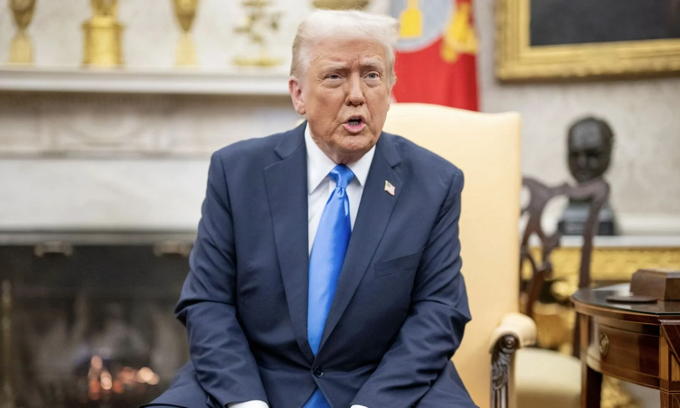
U.S. President Donald Trump told reporters at the White House on Feb. 12 that he expects Iran to make a deal with the United States quickly or face traumatic consequences.
“We have to make a deal, otherwise it’s going to be very traumatic, very traumatic,” Trump said, responding to a question about how talks were progressing.
“I don’t want that to happen, but we have to make a deal. They should have made a deal the first time, and they got Midnight Hammer instead, and this will be very traumatic for Iran if they don’t make a deal. Look, if they don’t make a deal, then it’ll be a different story.”
Asked about a timeline for an agreement, he said, “I guess over the next month, something like that … it should happen quickly.”
Trump said he had a good meeting with Israeli Prime Minister Benjamin Netanyahu on Feb. 11, adding that the Jewish state’s leader understands the situation but that “it’s ultimately up to me.”
The president said on Feb. 11 that Israel and the United States had not reached a final agreement on the Iranian issue.
“There was nothing definitive reached other than I insisted that negotiations with Iran continue to see whether or not a Deal can be consummated,” Trump wrote in a Feb. 11 post on Truth Social.
“If it can, I let the Prime Minister know that will be a preference. If it cannot, we will just have to see what the outcome will be.”
Trump’s comments follow remarks from Turkish Foreign Minister Hakan Fidan in an interview published in the Financial Times on Feb. 12 that both Iran and the United States were showing flexibility on the nuclear issue, with Washington appearing “willing” to tolerate some nuclear enrichment.
“It is positive that the Americans appear willing to tolerate Iranian enrichment within clearly set boundaries,” said Fidan, who has been involved in talks with both Washington and Tehran.
“The Iranians now recognize that they need to reach a deal with the Americans, and the Americans understand that the Iranians have certain limits. It’s pointless to try to force them.”
Washington has previously demanded Iran relinquish its stockpile of uranium enriched to up to 60 percent purity, a small step away from the 90 percent that is considered weapons-grade.
Negotiations continue amid revelations from human rights groups that the number of people who have died in the protests that rocked Iran earlier this year has topped 7,000.
At least 7,005 people, including 6,506 protestors, 219 children, 214 “government-affiliated forces,” and 66 “non-civilian non-protestors,” have died following the demonstrations as of Feb. 12, according to Virginia-based Iranian human rights organization HRANA.
HRANA relies on supporters in Iran to cross-check its information. It previously stated that the figures were based solely on “verified individual reports” and are likely to be much higher.
About 53,166 people have been detained during the protests, according to the organization. The Epoch Times is unable to verify the figures.
HRANA’s figure is more than double the death toll given by the Iranian government, which said on Jan. 21 that 3,117 people had been killed, according to the state-owned Islamic Republic News Agency (IRNA).
The government has, in the past, underreported or not reported fatalities from unrest, according to reports by the U.S. State Department, citing rights groups.
The protests were triggered by soaring inflation and the collapse of the Iranian rial, but expanded with some calling for the overthrow of the regime in Tehran, which marked 39 years in power on Feb. 11.








Let the bombs fall!