
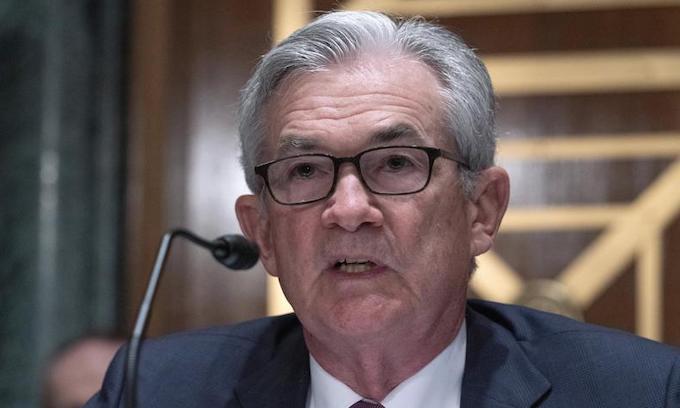
The search for a replacement for Federal Reserve Chair Jerome Powell is underway at the White House.
While President Donald Trump has confirmed that Powell will not be fired ahead of his term expiring in May 2026, senior administration officials have started pursuing candidates to lead the U.S. central bank for the next four years.
Trump and his team have not identified who these individuals are, with Treasury Secretary Scott Bessent telling the press that there are good internal and external candidates.
“There’s a formal process that’s already starting,” Bessent told Bloomberg Television on July 15. “There are a lot of good candidates inside and outside the Federal Reserve.”
Several names have circulated over the past several weeks, and the prediction markets have listed four heavyweight contenders as the next Fed chief.
Kevin Warsh
Kevin Warsh, a former Federal Reserve governor, has been repeatedly linked to the Trump administration.
In 2018, he was a top contender to serve as head of the Federal Reserve. Shortly after Trump won the 2024 election, Warsh was viewed as a candidate to helm the Treasury Department.
The special assistant to President George W. Bush for Economic Policy and Executive Secretary of the National Economic Council is now the leading contender to chair the U.S. central bank.
According to betting website Polymarket, Warsh has a 23 percent chance of succeeding Powell when his term expires in May 2026.
Trump has been complimentary toward Warsh, calling him “very talented.”
“But I don’t know that it’s going to be him. But he’s a very talented guy. He wouldn’t be doing what Powell is,” Trump said in a June interview with Fox Business host Maria Bartiromo.
Warsh, in recent months, has expressed sympathy for Trump’s frustration over Powell and the entire monetary policy establishment.
Speaking with CNBC’s Squawk Box on July 17, Warsh called for a “regime change” at the Fed for being too reliant on economic models and governance from a bygone era and suffering from a “credibility crisis.”
“We need regime change in the conduct of policy,” the Hoover Institution distinguished visiting fellow said. “The credibility deficit lies with the incumbents that are at the Fed, in my view.”
Warsh added that the Fed not cutting interest rates “is actually quite a mark against them.”
According to Warsh, Powell and his colleagues might be apprehensive about reducing rates since they made “the greatest mistake in macroeconomic policy in 45 years,” which contributed to the acceleration in inflation.
He also pointed to when the monetary authorities initiated the easing cycle in September, and the inflation data were comparable to today’s numbers.
Before the presidential election, the central bank pulled the trigger on a half-point reduction to the benchmark federal funds rate—a key rate that influences business, consumer, and government borrowing costs—the Personal Consumption Expenditures (PCE) Price Index was at 2.1 percent.
The Fed followed through on cuts totaling 50 basis points by December 2024, even as the PCE inflation rate climbed to 2.6 percent.
May’s PCE inflation came in at 2.3 percent, up from 2.2 percent in April.
The Cleveland Fed’s Inflation Nowcasting model expects it to come in at 2.5 percent for June.
Monetary policymakers pay more attention to the PCE than the Consumer Price Index, as the former includes a broader range of goods and services and accounts for changes in consumer behavior.
“It is very puzzling to me … how you could think that we should do emergency rate cuts last September, and now all of a sudden you stand there like a hawk,” Warsh added.
“That’s not good for the institution. I don’t think it’s good for the economy to be changing the goalposts like that.”
In addition to relying on outdated economic models, Warsh has said in multiple interviews that the Fed continues to shift the inflation goalposts, repeatedly changing its focus from wage inflation to supercore inflation (core services excluding housing).
Ultimately, Warsh agrees with Trump that rates need to be lowered.
“My simple version of this is run the printing press a little bit less, let the balance sheet come down, and let Secretary Bessent handle fiscal accounts, and you can have lower interest rates,” he told Fox Business host Larry Kudlow earlier this month.
Chris Waller
Fed Governor Chris Waller, nominated by Trump in 2019 to serve on the Federal Reserve Board and whose term runs through January 2030, has become a candidate in recent weeks.
According to Polymarket, Waller has a 14 percent chance of becoming the next chairman of the Federal Reserve.
Heading into the July 29—30 policy meeting, Waller has voiced support for lowering interest rates, hinting that he might be a dissenting vote.
Last month, Waller told Squawk Box that he thinks the Federal Open Market Committee could restart the rate-cutting cycle as early as the July meeting.
“Right now, the data from the last few months has been showing that trend inflation is looking pretty good, even on a 12-month basis,” Waller said.
“So I’ve labeled these good news rate cuts. If inflation comes down to target, we can actually bring rates down.”
He reiterated this position in a July 17 speech at a Money Marketeers of New York University event.
“I believe we should cut the policy rate at our meeting in two weeks,” said Waller, who first joined the St. Louis Fed in 2009.
One reason, says Waller, is that tariffs lead to one-time price adjustments “and do not cause inflation beyond a temporary surge.”
“Standard central banking practice is to ‘look through’ such price-level effects as long as inflation expectations are anchored, which they are,” he added.
The New York Fed’s June Survey of Consumer Expectations revealed that the one-year inflation outlook eased to 3 percent from 3.2 percent in May. Additionally, the three and five-year inflation expectations were unchanged at 3 percent and 2.6 percent, respectively.
Another facet, according to Waller, is that monetary policy needs to be closer to neutral rather than restrictive. The former means that interest rates neither stimulate nor slow down the economy, while the latter refers to rates cooling down economic growth.
Lastly, lower interest rates offset potential downside risks—slowing private-sector payroll growth and data revisions—to the U.S. labor market, Waller said.
“With inflation near target and the upside risks to inflation limited, we should not wait until the labor market deteriorates before we cut the policy rate,” he said.
Speaking with Bloomberg Television on July 18, Waller noted that the labor market is “on the edge.”
“The private sector is not doing as well as everybody thinks it is,” he said. “Most of the employment growth we saw last month was in the public sector, and that means the private sector is not doing particularly well.”
The U.S. economy added a better-than-expected 147,000 new jobs in June, and the unemployment rate dipped to 4.1 percent.
Private payrolls, meanwhile, increased by a smaller-than-expected 74,000 last month, down from a downwardly adjusted 137,000 in May.
During a June 20 interview with Squawk Box, Waller referenced the long and variable lag that monetary policy functions on, meaning that the Fed should start cutting now before the employment outlook deteriorates.
“Why do we want to wait until we actually see a crash before we start cutting rates?” he said.
“So I’m all in favor of saying maybe we should start thinking about cutting the policy rate at the next meeting, because we don’t want to wait till the job market tanks before we start cutting the policy rate.”
When asked about the prospects of ascending to head of the Federal Reserve, Waller said he would accept the position.
“If he says, ‘Chris, I want you to do the job,’ I’ll say ‘yes’. But he’s not talking to me,” he said. “It’s a hypothetical that isn’t relevant.”
Scott Bessent
Even before rising to the rank of Treasury Secretary, Scott Bessent has been highly critical of the U.S. central bank.
In an October interview with Barron’s, Bessent proposed the concept of a “shadow Fed chair,” a plan that would involve replacing Powell before his term expires next year.
“You could do the earliest Fed nomination and create a shadow Fed chair,” Bessent said. “And based on the concept of forward guidance, no one is really going to care what Jerome Powell has to say anymore.”
Bessent has since backed off from this proposal, echoing the president’s sentiment that Powell can stay on as the central bank chief until May 2026.
Like Warsh, Bessent has been highly critical of both Powell and the institution.
“What we need to do is examine the entire Federal Reserve institution and whether they have been successful,” Bessent said in a July 21 interview with Squawk Box.
“All of these PhDs over there, I don’t know what they do. This is like Universal Basic Income for academic economists.”
Could Bessent be Powell’s successor? Polymarket has Bessent sitting at 14 percent odds.
If chosen, it would be unprecedented because no Treasury Secretary has served as chairman of the Federal Reserve simultaneously.
Before the Banking Act of 1935, the Treasury Secretary was a member of the board, although there was no formal nomination process.
The legislation was integral to bolstering central bank independence.
While the bill—signed by President Franklin D. Roosevelt in August 1935—restructured the composition of the Fed, it does not prohibit the Treasury Secretary from serving as the institution’s head.
It did, however, remove the Cabinet position and Comptroller of the Currency from automatic seats on the board.
Should Bessent be appointed as Fed Chair while serving as Treasury Secretary, experts say it would potentially threaten the tradition of central bank independence.
Additionally, performing full-time duties at the Treasury Department and the Federal Reserve would be a significant challenge.
Bessent, meanwhile, has downplayed reports that Trump is considering him to lead the Fed.
At the same time, he has not ruled out the possibility.
“I’m very happy in my job here. I think we have lots of good candidates for Fed chair. We will start working on that in the fall. We’ve been busy,” Bessent told CNBC’s Money Movers earlier this month.
Kevin Hassett
National Economic Council Director Kevin Hassett has been floated as a potential candidate for the Fed, with the predictions market giving Hassett 14 percent odds of being selected by the president.
Similar to his administration colleagues, Hassett has been highly critical of the Fed, suggesting that Trump could fire Powell “if there’s cause.”
He specifically pointed to the central bank’s years-long $2.5 billion renovation project that has gone $700 million over budget.
Hassett, speaking with ABC News’ This Week on July 13, revealed that whether Trump can fire Powell is “being looked into.”
“But certainly, if there’s cause, he does,” he said.
However, while Hassett has not explicitly stated that he would accept a position at the Fed, he has indicated that the president’s objective of downsizing the federal government includes the central bank.
“I’m sure that whatever leadership the president chooses for the new Federal Reserve that they are going to pay close attention to the runaway spending, to the actual losses after years and years of profits,” Hassett said.
In March, the Federal Reserve confirmed that its net loss in 2024 was $77.5 billion, down from $114.6 billion in 2023. The Fed has not turned a profit since 2022.
The second consecutive annual loss has been attributed to higher interest payments, low-yielding assets, and rising operating costs.
Echoing the president, Hassett also believes that the Fed should lower interest rates akin to the European Central Bank, which has cut rates eight times since June 2024.
Hassett told Fox Business’s Larry Kudlow on July 10 that the Fed policy rate would be about 3 percent if the monetary authorities compared the European Central Bank’s rate cuts to the normal correlation of current Fed policy.
“So, the president is wondering why it is that the normal correlation seems to be breaking down right now, precisely while he’s president,” he said.







How’s about someone off the wall.. such as mr leary.