

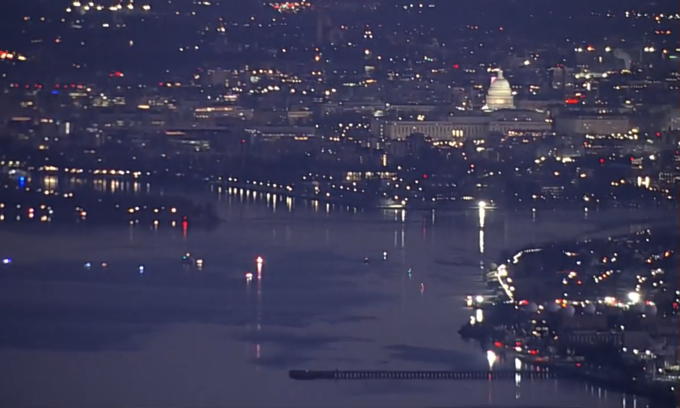
The National Transportation Safety Board (NTSB) on Jan. 27 revealed the probable cause of last year’s deadly midair collision over Washington’s Potomac River, citing the Federal Aviation Administration’s (FAA) decision to place a helicopter route close to an airplane runway approach path and several other “systemic failures” at the agency.
“This was 100 percent preventable,” said NTSB Chair Jennifer Homendy.
The more than nine-hour hearing was the culmination of the NTSB’s yearlong investigation into the midair collision between a CRJ700 commercial jet and an Army Black Hawk helicopter on Jan. 29, 2025, which resulted in the deaths of all 67 people aboard both aircraft.
The NTSB, an independent agency that investigates transportation accidents for the federal government, included a series of missteps by both the FAA and the Army in its probable cause summary of the incident, but emphasized the impacts from the executive branch’s decision to allow a helicopter route so close to a runway approach path at Ronald Reagan Washington National Airport.
“Number one, this helicopter route shouldn’t have been there in the first place. This was terrible design of the airspace,” Homendy said toward the end of Tuesday’s hearing.
The NTSB also faulted the FAA for failing to adequately review data that indicated the risk of a midair collision within the airspace around the Potomac and for allowing air traffic controllers to rely on “visual separation” to ensure “efficient traffic flow.”
The Army’s “lack of a fully implemented safety management system,” which the NTSB noted could have determined and addressed the risks associated with exceeding the maximum allowed altitudes for helicopters in Washington’s airspace, was also included in the list of causal factors.
Here are several takeaways from the NTSB’s probable cause hearing into the deadliest U.S. aviation accident in the past 25 years.
Systemic Failures at FAA
Homendy said it was a series of “underlying systemic failures” that ultimately led to last year’s collision.
Aside from allowing helicopter traffic so close to commercial airplanes within the airspace around the U.S. Capitol, the FAA also has a history of pushing back against NTSB recommendations, the chair said, often telling the independent agency that “we can’t do it this way, we need to find another [option].”
Homendy said that under the leadership of Transportation Secretary Sean Duffy and FAA Administrator Bryan Bedford, the Transportation Department and FAA have both committed to implementing new location transmitting technology on aircraft, but said the previous FAA administrator resisted. She likened the impasse to “having a conversation with a wall.”
But it was the FAA’s alleged misuse of its own data that was cited as an even bigger contributing cause for the collision.
“The question is, should the FAA have known there was a problem, and should something have been done? Absolutely, the data was there. The data was in their own systems,” Homendy said. “It was the NTSB working with them to determine that there were 15,214 close-proximity events, 85 of which were serious, over a number of years. That’s just the data.”
She chastised the agency for collecting data and not analyzing it, and said the FAA was supposed to conduct annual reviews of its helicopter routes to ensure they were still safe.
Staffing, Human Factors Issues
As previous NTSB hearings into the collision indicated, Reagan National Airport’s control tower has had persistent staffing issues for years, and a single air traffic controller was handling frequencies for both airplanes and helicopters on the night of the incident.
Homendy said the issue was compounded by controllers viewing the tower as essentially a “training facility” due to it paying lower salaries than other locations.
“They can’t attract people here, which is a problem, and which is why we’re making some recommendations on that number grant,” she said.
The NTSB concluded at the end of its hearing that even though the control tower at Reagan National, which goes by the code DCA, was not staffed at its “largest target level” on Jan. 29, 2025, the number of staff in the tower that evening “was adequate” and in accordance with FAA directives.
However, since the tower’s operations supervisor was working an extended shift that night, he was “likely experiencing reduced alertness and vigilance, which decreased his awareness of the operational environment and reduced his ability to proactively assess the risks posed by the traffic and environmental conditions,” the NTSB concluded.
Additionally, the NTSB said the lack of mandatory supervisory air traffic control staff is “contrary to human factors research” that illustrates a “clear performance deterioration in situations of prolonged time on task.”
Visual Separation
“Reliance on pilot-applied visual separation, see-and-avoid as a primary means of separating mixed traffic, introduced unacceptable risk to the Ronald Reagan Washington National Airport, class-B airspace,” the NTSB said in its summary.
Homendy faulted the FAA for allowing air traffic controllers to extensively use “pilot applied visual separation,” which allows a pilot to use line of sight as a means of avoiding other air traffic, rather than relying on radar or other location tracking technology.
This is particularly problematic within the airspace around Washington and near the helicopter routes running so close to commercial jet traffic, the NTSB said.
“Frankly, having a helicopter route crossing, runway three, with only 75 feet of … vertical separation—what that means is 75 feet at best, separating a helicopter and civilian aircraft. Nowhere in the airspace is that OK,” Homendy said.
The NTSB is recommending that all aircraft utilize ADS-B In and Out, which is location tracking technology that both receives and transmits aircraft data. However, if a single aircraft is lacking ADS-B In while possessing ADS-B Out, it can transmit its own location, but can’t see other aircraft.
Critically, the FAA had not approved the use of ADS-B In for the CRJ700 jet involved in last year’s midair collision.
Homendy said the NTSB had recommended using ADS-B In on aircraft at least 17 times since 2006, but the FAA had dismissed the recommendation, including during the previous administration.
Army’s Impacts
The NTSB also cited mistakes made by the Department of War.
Critically, the Army failed to create and implement a safety management system, which the NTSB said could have identified and addressed “hazards associated with altitude exceedances on the Washington, D.C., helicopter routes.”
There were also critical issues with the Black Hawk helicopter’s altimeter system, which reported a false altitude reading to its pilots on the night of the crash.
“It is likely that the crew of PAT25 observed a barometric altimeter altitude about 100 feet lower than the helicopter’s true altitude, resulting in the crew erroneously believing that they were under the published maximum altitude for route four,” the NTSB said.
Outrage from NTSB Over Safety Lapses
The NTSB on Tuesday shared its ongoing frustration with the FAA over what the independent agency described as repeated failures to adhere to its safety recommendations and prevent loss of life.
“We can talk about traffic. What we need to really talk about is a tower and tower personnel who were repeatedly saying, ‘We have a safety problem here. We have a hot spot at the end of runway three, and we need to do something about it. We have helicopter routes where we have unsafe practices right now, we need to do something,’” Homendy told reporters during a hearing recess on Tuesday.
“So I will also get the, ‘Oh, she sounds angry.’ We should be angry. Because for years, no one listened. This was preventable. This was 100 percent preventable.”
The FAA said it “values and appreciates the NTSB’s expertise and input” in a statement to The Epoch Times.
“We have worked side by side with the NTSB throughout this accident investigation and acted immediately to implement urgent safety recommendations it issued in March 2025. We will carefully consider the additional recommendations the NTSB made today,” the FAA said.
The FAA said, after the tragedy it reduced hourly arrivals at DCA from 36 down to 26, and also restricted helicopter traffic. Since then, the arrivals have increased gradually up to 30 per hour where it is now, after assessing that level could be safely handled.
Staffing at the tower—including air traffic controllers and other support and operations staff—were also increased.









Essentially saying “WE screwed up, but no one is going to be held accountable”.