

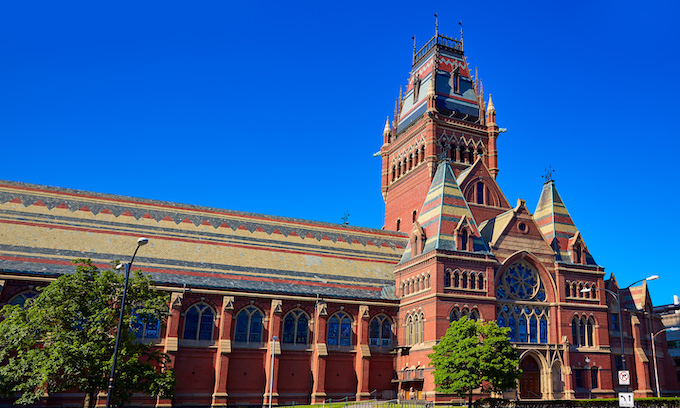
BOSTON—A federal judge heard arguments on June 16 over whether to issue a more permanent block on the Trump administration’s attempt to halt the flow of foreign students into Harvard University.
The hearing was the latest in a series of confrontations between President Donald Trump and the school he says has failed to address anti-Semitism and has foreign entanglements that threaten national security. Harvard says that Trump is using their foreign students as a pawn in what it says is a broader unconstitutional assault on the school and its academic freedom.
During the June 16 hearing, an attorney for Harvard sought to convince U.S. District Judge Allison Burroughs that she should issue a preliminary injunction on a proclamation Trump issued this month. Burroughs already issued a brief, more temporary order this month in order to halt the proclamation, which places a six-month pause on Harvard accepting new foreign students through visas.
She refrained from ruling on the issue during the hearing but indicated a decision could be coming within a week. As of the hearing’s conclusion, Trump’s actions remain blocked by the court until June 23.
When Burroughs issued her initial block on Trump’s proclamation, she didn’t offer much in the way of reasoning on the constitutional issues involved. On June 16, she seemed concerned about Trump potentially violating the First Amendment by targeting Harvard.
She also said the administration had an uphill battle in arguing whether its actions created irreparable harm, which is one of the factors judges consider when deciding whether to issue preliminary injunctions.
In both this lawsuit and another from Harvard, the school alleged that Trump was retaliating over its refusal to fulfill various demands the Justice Department made over concerns about anti-Semitism and ideological bias.
Justice Department attorney Tiberius Davis told Burroughs on June 16 that the administration had good reason to target Harvard and that it could be somewhat selective in choosing which institutions to pursue. He also noted that the Justice Department had targeted many other schools for investigation.
Davis cited multiple concerns about Harvard, such as alleged hate crimes on campus, its allegedly illegal use of affirmative action, and a purported failure to discipline its students who engaged in wrongdoing. Overall, he said the administration didn’t trust Harvard to vet its foreign students.
This particular lawsuit was filed after a separate action by the Department of Homeland Security to decertify Harvard under the foreign visa program. Burroughs issued a temporary block on that action as well and said she thought the university encountered harm related to the First Amendment. After the administration backed away from that move, however, it pursued the proclamation as a different legal avenue for halting the flow of foreign students to Harvard.
Trump’s proclamation, entitled Enhancing National Security By Addressing Risks at Harvard University, was more limited than the decertification effort and prohibited the entry of nonimmigrant foreigners to pursue a course of study at Harvard.
In it, Trump expressed concern about foreign students’ activities and the universities’ “entanglements with foreign countries.” He also pointed to multiple federal investigations into the university and accused it of violating Supreme Court precedent through affirmative action.
Harvard alleged that Trump was attempting an “end run” around Burroughs’s block on the administration’s initial attempt to decertify the university as an institution that participated in the Student Exchange Visa Program. The Justice Department rebutted that allegation, stating that it was “free to explore other legal avenues to accomplish its legitimate goals.”
Trump’s proclamation had invoked a section of federal law that allows presidents to restrict entry to classes of foreigners whom they view as detrimental to U.S. interests. It was the same portion of federal law that Trump used for the travel ban he implemented during his first administration.
In Trump v. Hawaii, the Supreme Court upheld Trump’s travel ban, stating that federal law gives presidents “broad discretion.” Tiberius, the Justice Department attorney, cited this case as a reason for Burroughs not to grant Harvard’s request for a preliminary injunction.
Harvard’s attorney argued that the case didn’t support the administration’s actions against the university partly because the case wasn’t about the federal government targeting the speech of a domestic entity.




It is only fair to the foreign students to tell them now, they are no longer wanted or trusted, to give them enough time to enroll in classes in the fall and should seek to get their socialist anti-American Harvard type education in a communist or terrorist country that actually practices these social delusions. I’d recommend perhaps Tehran or Moscow where Bernie still mentally honeymoons, that soon will be holding classes on how to dodge incoming American missiles.
Note: any and all Judges who attended the Harvard school of law should be forced to recuse themselves from judging this issue. Up to and including the Supremes.
IMO GET RID OF all foreign students.. Especially those from china!