
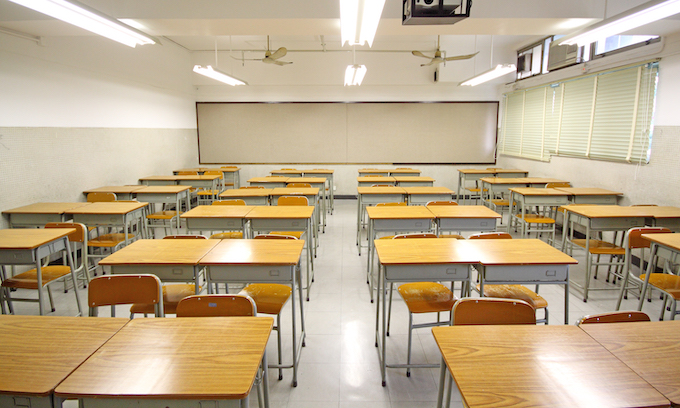
As schools open for the 2024–2025 academic year, states differ on how teachers should deal with disruptive students.
Some are pushing for a more punitive approach, with suspensions for repeat offenders, while others disapprove of removing students from classrooms.
In California, Assembly Bill 1919 calls for a K–12 “restorative justice program” to be implemented by the fall of 2026.
As an alternative to suspension, unruly students would be referred to social workers or child psychologists or placed in anger management programs.
The legislation encourages a case management approach where a team of school support service professionals customize a student’s plan to improve behavior. It does allow for suspensions for more severe cases of bullying or violent behavior, and racist incidents require additional interventions.
“Local educational agencies are encouraged to require perpetrators to engage in culturally sensitive programs that promote racial justice and equity and combat racism and ignorance,” the bill reads.
A state Senate committee is scheduled to discuss the legislation on Aug. 15.
In West Virginia, Senate Bill 614 could be discussed when legislators reconvene later in August.
Under the legislation, elementary school students in grades K–5 who engage in violent, threatening, or intimidating behavior toward students or staff can be suspended and then placed in an alternative school, or a county behavior intervention program.
West Virginia has 55 counties but only 34 such programs, so the measure also calls for transporting students to other facilities in certain situations, according to a news release issued by the West Virginia Legislature earlier this year.
A similar law for students in grades 6–12 took effect last summer.
At the close of the 2024 legislative session, Virginia Gov. Glenn Youngkin vetoed a bill that, like California’s, called for restorative justice measures against student offenders over school suspensions.
In his decision, he cited a Nov. 17 incident in Charlottesville in which police responded to complaints at the high school twice in one day.
Twenty-seven teachers then declined to return to school.
“Teachers who are concerned about decaying discipline in our schools consistently point to a failure to confront and address the small number of students who are responsible for this violence,” Youngkin wrote in his decision, according to the Virginia General Assembly website.
“Fundamentally, for our schools to be safe places for young Virginians to learn and become active citizens, they must be safe. The bill proposes a top-down mandate, forcing school administrators to first utilize restorative practices rather than immediately suspending or otherwise disciplining students who are violent in school.”
Teacher Bill of Rights amendments in Louisiana and Alabama were signed into law at the end of the 2024 legislative sessions and are now in effect.
Teachers in both states can send disruptive students to the principal’s office, where administrators then decide on punishments like detention or suspensions.
Advocates say these laws ensure that school administrators support teachers if there’s pushback from parents.
“Campus and classroom disruptions are hindering the teaching profession and student learning,” Louisiana Education Superintendent Cade Brumley said in a July 31 news release the day before the law took effect.
“As we approach a new school year, please recommit to assertive discipline action to create safe and orderly environments where teaching and learning can flourish. Students and teachers deserve peaceful schools.”
The Alabama law also has a “liability trust fund” and legal reimbursement measures to help school employees who are sued or charged criminally for their actions.
Student behavior remains a problem in this post-pandemic era of learning, according to the U.S. Department of Education’s National Center for Education Statistics.
Most of the 116 public schools representing different regions of the country that participated in a May survey indicated that incidents of student fighting, cutting class, cyberbullying, and threatening teachers have occurred in the past year.
Eighty-three percent of the schools surveyed said the lingering effects of COVID-19 continue to impact the emotional development of students.
The Florida Bill of Rights that took effect last year has “a right to control the classroom” section that allows teachers to establish a classroom code of conduct, remove disruptive students, and obtain training in violence prevention, classroom management, and conflict resolution.
It also requires school leaders to give teachers the benefit of the doubt when matters escalate to litigation, according to the Florida Department of Education.
The National Association of School Psychologists maintains that repeated detentions and suspensions don’t help students improve their behavior and instead discourage them from learning, said Peter Faustino, the organization’s president and a school psychologist in the Scarborough, NY district.
While educators are responsible for maintaining a safe environment where all students have a right to learn and should not be disrupted by their unruly peers, Faustino said, there’s a better way to establish rules and expectations from the start—before kids become disengaged, bored, and problematic.
“There’s a code of conduct that must be explained to the rule-breakers, but before something escalates to the discipline phase, we should be as positive and proactive as we can,” Faustino told The Epoch Times on Aug. 6.
“Sometimes it’s just a matter of telling them what they should do instead of what they shouldn’t do.
“If they’re engaged in classroom activities, they’re less likely to act out. And if they’re not engaged, find out why. Adults must adjust to this, too.”








“As an alternative to suspension, unruly students would be referred to social workers or child psychologists or placed in anger management programs.”,,,,,,Hogwash ! The disobedient student should be given 2 options,,,,a butt whipping by a school assigned disciplinarian, or having their parents come in to do the job proper. If they choose the school disciplinarian the first incident will not be reported to their parents. All other punishments will be parent notified, and if the parent refuses to participate, the punishment doubles, right before the kid gets thrown out of the school for good. Schools are places for teaching, not baby sitting or enabling human weaknesses. By HIS stripes, we as a society are healed. As Jesus took his for the team, so can these disobedient brats for the greater good of society.
Spare the rod SPOIL the child!
That phrase has never meant as much as it does now, with our utter coddling of kids these days.
When i went to school, even in the 80s, spankings were STILL ALLOWED< and we didn't see even 1/5th of the level of problems in school, as we do now…
“Eighty-three percent of the schools surveyed said the lingering effects of COVID-19 continue to impact the emotional development of students.”
The lingering effects of government COVID policies, more likely. Or if you like, the effects of covert U.S. government bacterial research in co-operation with Communist China (the China that hates us).
The best way To control and discipline a child Is Take away Public assistance. Let it effect The mother’s pocketbook. Money speaks. !! If a child won’t behave Then the mother Can get a job and support the child.