


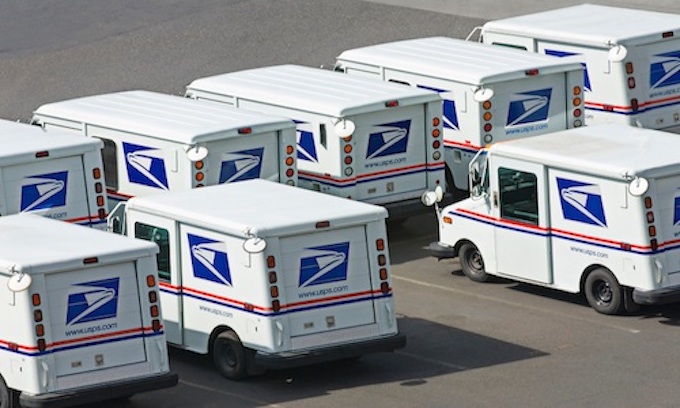
On Aug. 29, the United States ended a trade policy that facilitated the shipment of low-value goods into the country for years.
Politicians on both sides of the aisle support the move, while the rapid transition constitutes a massive change of business for international shippers.
At midnight on Friday, the United States took an existing policy blocking the so-called de minimis exemption on goods shipped from China and Hong Kong and expanded it to cover the entire world. That move was ordered by President Donald Trump on July 30.
The president’s order stated that the exemption had been fueling drug trafficking and unfair trade practices that hurt American businesses.
In a press call on Aug. 28, Peter Navarro, a senior counselor for trade and manufacturing to the president of the United States, said the move is ending a loophole that will “save thousands of American lives by restricting the flow of narcotics and other dangerous and prohibited items.”
According to Navarro, the policy change will “add up to $10 billion a year in tariff revenues to our Treasury, create thousands of jobs, and defend against billions of dollars more lost to counterfeiting, piracy and intellectual property theft.”
Going forward, the United States will collect duties on all shipments that enter the country. Before Aug. 29, goods worth less than $800 were exempted from import fees.
On the press call, a senior administration official said that all postal shipments will be assessed using one of two methods.
The first is a so-called ad valorem duty, which is a duty equal to the effective tariff rate imposed under the International Emergency Economic Powers Act (IEEPA) tariffs that apply to the country of origin of the product. That duty will be assessed based on the value of the package.
The second option is a specific duty, which will range from $80 per item to $200 per item, depending on the effective IEEPA tariff rate applicable to the country of origin of the product, the senior official said.
The specific duty option is only available for six months, after which all shipments must use the ad valorem method.
On the press call, Navarro said there will not be any reversal of the policy and that the de minimis change is not a negotiating tactic.
As the Trump administration aims to reorganize the global trade order through tariffs and bilateral deals, officials say they are focused on stopping transshipment of goods originally made in China and shipped to the United States through a proxy country. On the call, Navarro accused Chinese shippers of transshipping after the United States ended de minimis practices for Chinese goods in May.
International Reaction
Ending the exemption globally has drawn a reaction from national postal services and e-commerce companies.
In a statement, the Universal Postal Union, a specialized agency of the United Nations, said that 25 national postal services have temporarily suspended their outbound postal services to the United States “citing uncertainties specifically related to transit services.”
Those countries include Australia, Austria, Belgium, Denmark, Finland, France, Germany, India, Italy, Japan, New Zealand, Norway, Spain, Sweden, Switzerland, Thailand, and the United Kingdom.
Additionally, leaders of eBay and United Parcel Service have publicly warned that the global change could either disrupt their business or cause consumers to pay higher prices.
In an Aug. 28 article, Elena Patel, co-director of the Urban-Brookings Tax Policy Center and a senior fellow in the Economic Studies Program at the Brookings Institution, said businesses that have organized their supply chain to take advantage of a relatively lax policy in the United States are likely to be affected by the change.
Patel said that the United States should end the de minimis exemption, but that “scrapping a nearly century-old policy in less than a month” does not make sense.
Representatives of the Brookings Institution did not immediately respond to a request for comment from The Epoch Times.
On the Aug. 28 call, Navarro said that those foreign post offices “need to get their act together when it comes to monitoring and policing the use of international mail for smuggling and tariff evasion purposes.”
On the press call, a senior administration official said that none of the world’s postal services should be surprised by the Friday move. The official mentioned that Customs and Border Protection published at least four notices detailing its practices and “conducted extensive outreach, including stakeholder calls and engagements to ensure that the trade community is fully informed and prepared.”
History of De Minimis Exemption
The de minimis exemption was originally authorized by Congress in 1930. Under Section 321 of the Tariff Act, the United States allowed certain goods to move into the country without any fee. The policy was drafted to avoid wasting public resources to collect a trifling amount of revenue.
In 2016, the de minimis threshold was most recently raised to $800 from $200. That increase, according to data collected by the Customs and Border Patrol, enabled a significant increase in the number of packages that flowed across the border.
Between 2015 and 2024, the number of packages falling under the exemption rose to 1.36 billion from 134 million, according to Customs and Border Patrol data reviewed by the Congressional Research Service. Through June 30, Customs and Border Patrol tracked 309 million de minimis packages this fiscal year, which is nearly twice the 115 million it counted in all of fiscal year 2024. Most of those packages originated in China.
Members of both parties have identified the de minimis issue as potentially harmful for the American economy. In 2024, the Biden Administration’s White House said it would begin the process of taking action on the de minimis problem.
On the call, Navarro said the huge number of small packages poses two risks for Americans.
First, the minimal screening makes it easier for contraband to enter the country. He said fentanyl and other drugs, along with counterfeit goods and dangerous items, are often smuggled into the country in de minimis packages. Second, American retailers say the relatively high threshold for de minimis packages enables foreign competitors to undercut domestic products.
In similar statements, both the leaders of Alliance for American Manufacturing and the National Council of Textile Organizations cheered the cessation of the exemption as a win for Americans.
In an Aug. 28 statement, National Council of Textile Organizations President and CEO Kim Glas called the de minimis exemption a “backdoor pipeline for cheap, subsidized, and often illegal, toxic and unethical imports.”
The Alliance for American Manufacturing said in a July 31 statement that the de minimis exemption “rocketed Shein and Temu to retail dominance” at the expense of American retailers, their employees, and their suppliers.
The precise effect of the policy change, which hit Chinese shippers in May, remains unclear. Both online retail giants have remained largely silent on the issue aside from issuing limited statements about reorganizing their supply chains.
However, in a July earnings call, UPS CEO Carol Tomé observed that its daily average delivery volume dropped by 34.8 percent during May and July. Those declines were likely linked to less parcel traffic between China and the United States immediately following the implementation of the May de minimis order.
Moreover, PDD Holdings Inc., a publicly traded e-commerce company nominally based in Dublin, Ireland, which operates the online marketplace Temu as well as Chinese marketplace Pinduoduo, reported on Aug. 25 that its operating profits were down by more than 21 percent from the same quarter a year prior.
Representatives of Shein and Temu did not immediately respond to a request for comment from The Epoch Times.






And who makes that ‘low cost crud’. CHINA!