

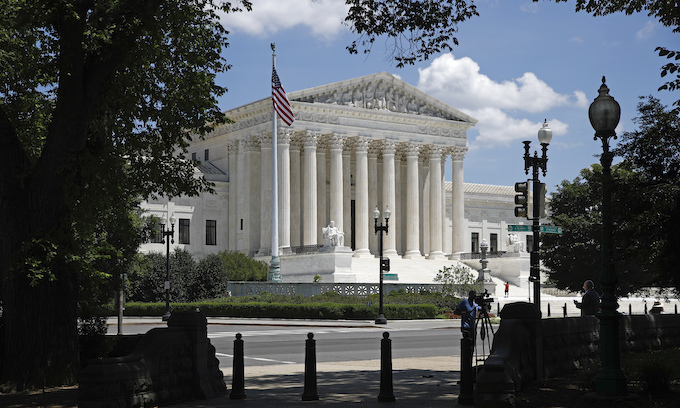
(The Center Square) – The U.S. Supreme Court handed down four more rulings Thursday, including a 6-3 decision solidifying states’ right to block abortion services from receiving Medicaid funding.
The justices also gave opinions on challenging a deportation ruling, DNA testing in a capital murder case and interpretation of the First Step Act.
Medicaid abortion coverage
Medina v. Planned Parenthood South Atlantic
6-3 ruling
The nation’s top court voted along ideological lines to support South Carolina’s 2018 decision prohibiting abortion clinics from receiving reimbursement under Medicaid.
A South Carolina Planned Parenthood sued the state alongside a patient, saying the ban infringed upon the patient’s right to choose her medical provider.
Writing for the majority, Justice Neil Gorsuch argued that the power to decide who is deemed an eligible medical provider under a state’s Medicaid program should lie with the states.
This power “belongs to the people’s elected representatives, not unelected judges charged with applying the law as they find it,” Gorsuch wrote.
The court’s decision lays the groundwork for other states to follow suit in defunding Planned Parenthood under their respective Medicaid programs.
Illinois Planned Parenthood Interim President Tonya Tucker responded to Thursday’s ruling, saying it “sets a troubling precedent that extends far beyond South Carolina.”
Deportation challenge
Riley v. Bondi
5-4 ruling
The Supreme Court ordered, in a 5-4 decision, for a lower court to reconsider its decision denying a man’s deportation challenge due to threats of violence in his home country.
One immigration judge initially granted the man relief, while another ordered for him to be deported to Jamaica. His appeal of the decision was blocked by a circuit court because he did not appeal in the 30-day deadline.
However, the 30-day deadline from his original ruling to stay in the country had passed by the time a separate court ruled he should be deported. Since he did not file within 30 days of the original ruling, a circuit court dismissed his case.
Justice Samuel Alito’s opinion primarily took issue with the lower court’s reversal of the man’s deportation appeal on claims that the case was jurisdictional, because of the 30-day window for appeal of a deportation case.
“Courts should treat a ‘statutory limitation’ as jurisdictional only if Congress ‘clearly states’ that the provision has jurisdictional consequences,” Alito wrote. “Our cases have almost uniformly found that the provisions at issue failed to meet this very demanding test,” he added.
The court’s instruction in the matter means the 30-day deadline can be subject to certain circumstances, including if a plaintiff is not able to file an appeal in time.
DNA testing in murder trial
Gutierrez v. Saenz
6-3 ruling
The Supreme Court backed a man on death row in Texas on Thursday, ruling that a lawsuit over DNA testing can proceed.
The court overturned a lower court’s opinion that Ruben Gutierrez cannot sue a district attorney after his request for DNA testing pertaining to his 1998 murder case was denied. Gutierrez maintains that this testing will prove his innocence.
Justice Sonia Sotomayor defended Gutierrez’s right to challenge the district attorney under the Constitution’s right to due process in the court’s majority opinion.
First Step Act provision
Hewitt v. United States
5-4 ruling
In a ruling largely dependent on interpreting grammar, the justices ruled in favor of criminal defendants seeking a sentence reduction under the First Step Act.
The court was tasked with determining if the law’s mandatory-minimum sentence provision applies to a defendant who was initially sentenced before the law was adopted but then whose sentence was vacated, resulting in a resentence taking place after the law’s enactment.
Justice Ketanji Brown Jackson upheld the First Step Act sentencing in the majority opinion.
What’s coming next?
The justices are pushing to clear their docket before the scheduled summer recess. They will release all six of the remaining decisions Friday morning.
The most notable of these cases involves President Donald Trump’s Jan. 20 executive order ending birthright citizenship. The court will decide if federal district judges have the authority to block implementation of Trump’s ruling across the country through what is known as a “nationwide injunction.”









Some good calls there..
Planned Parenthood, the oxymoronic named so-called healthcare organization that killed the very thing of “Parenthood’ that they beguilingly inserted into their name, and like the true healthcare quacks that they are, got a taste of their own medicine from our Supreme Court,,,,,They got aborted from the ability to eat from the pig trough of tainted government misused filthy lucre. American Justice has finally come home along with many now saved souls of our American innocence. What a shame we cannot abort inane Justices like Biden nominated Ketanji Brown who if Trump had not had the 2020 election stolen could have cleaned out one more miscreant Democrat party operative nominated Justice unable to even tell you what a real woman is, or what the value of innocent American human life really is. This is what you get when a party of death and destruction is allowed to nominate soulless secular women to the highest level of office who forget what they are, what CREATORS they were created to be and should be the first in line behind even the men to protect human life in the womb. The one Trump nominated woman of the four women that now serve is a true gatekeeper protector as God designed a real woman to be. The others remind me of gargoyles perched in high places to scare off evil, who have become the very evil themselves.