
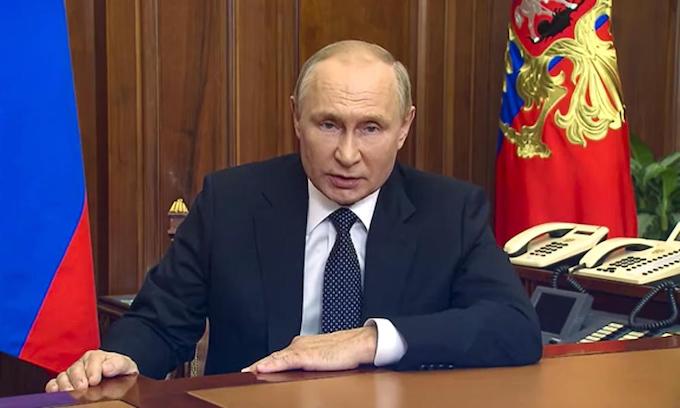
Russian President Vladimir Putin said on Sept. 1 that the issue of NATO’s eastward enlargement has to be tackled for there to be a sustainable peace deal in Ukraine.
Putin was speaking after talks with the Chinese leader Xi Jinping and Indian Prime Minister Narendra Modi at the Shanghai Cooperation Organisation (SCO) meeting in Tianjin, China.
Putin said the crisis in Ukraine was partly due to “the West’s constant attempts to drag Ukraine into NATO, which, as we have repeatedly emphasized and said over many years, poses a direct threat to Russia’s security.”
He said that the 2014 revolution in Ukraine was a “coup” in which “the country’s political leadership that opposed NATO membership was removed from power.”
“In order for a Ukrainian settlement to be sustainable and long-term, the root causes of the crisis, which I have just mentioned and which I have repeatedly mentioned before, must be eliminated.”
Putin Calls for ‘Fair Balance’
Putin also called for “a fair balance in the security sphere” to be restored.
In February 2022, Russia invaded Ukraine—which has expressed interest in joining NATO—and its forces now control a fifth of the country, including Crimea and large swathes of the south and east of Ukraine.
Just days before the invasion, Putin delivered a speech describing the potential accession of Ukraine to NATO as “a direct threat to the security of Russia.”
In the wake of the Russian invasion, Finland and Sweden both waived policies of neutrality they had held for decades and joined NATO in 2023 and 2024, respectively.
NATO now has 32 members, including a string of countries that were once part of the Soviet Union—such as Lithuania, Latvia, and Estonia—or part of the Moscow-dominated Warsaw Pact alliance during the Cold War—such as Poland, Romania, and Bulgaria.
Apart from Ukraine, two other countries—Georgia and Bosnia-Herzegovina—have applied for NATO membership.
On the alliance’s website, it states: “NATO’s door remains open to any European country in a position to undertake the commitments and obligations of membership, and contribute to security in the Euro-Atlantic area.”
During NATO’s 2008 summit in Bucharest, alliance leaders said in a declaration: “NATO welcomes Ukraine’s and Georgia’s Euro-Atlantic aspirations for membership in NATO. We agreed today that these countries will become members of NATO.”
But after NATO’s summit in The Hague in June, there was no mention of Ukrainian membership in the declaration issued, which stated simply, “Allies reaffirm their enduring sovereign commitments to provide support to Ukraine, whose security contributes to ours.”
‘Understandings’ Reached in Alaska
President Donald Trump met Putin in Alaska on Aug. 15, in an attempt to resolve the conflict in Ukraine.
On his way to the summit, Trump was asked by reporters whether the United States would be willing to provide security guarantees to Kyiv. He replied, “Maybe,” but made clear this would not involve admitting Ukraine as a member of NATO.
In an interview on Aug. 29, Trump said a one-on-one meeting between Putin and Ukrainian President Volodymyr Zelenskyy may not be likely anytime soon.
“A [trilateral meeting] would happen. A [bilateral], I don’t know about, but a [trilateral] will happen. But, you know, sometimes people aren’t ready for it,” Trump said.
The Russian president said he had shared details with Xi about the Alaska summit and work was “already underway” to resolve the conflict.
“The understandings reached at the recent Russia–U.S. meeting in Alaska, I hope, also contribute toward this goal,” Putin said.
“We highly appreciate the efforts and proposals from China and India aimed at facilitating the resolution of the Ukrainian crisis,” Putin said at the Tianjin summit.
Trump Ramps up Pressure on India
India imports large amounts of oil and gas from Russia, and Modi described his country’s relationship with Moscow as “special and privileged.”
Putin said Modi was a “dear friend” and added, “Russia and India have maintained special relations for decades. Friendly, trusting. This is the foundation for the development of our relations in the future.”
“To end the conflict soonest and establish peace permanently, we need to find out a way. It’s a call of the entire humanity,” Modi said, referring to the war in Ukraine.
The relationship between New Delhi and Moscow dates back to Aug. 1971, when India and the Soviet Union signed a treaty of “peace, cooperation and friendship” during the war in East Pakistan—what is now Bangladesh.
In an Aug. 6 executive order, Trump implemented an additional 25 percent tariff on India, saying New Delhi is “currently directly or indirectly importing Russian Federation oil, [that is] fueling the [Russian] war machine.”
On Aug. 27, the new tariffs, totalling 50 percent for imports from India, came into force.
The Associated Press and Reuters contributed to this report.



What a crock. Putin is nothing more than a low life would be Joe Stalin. Trump has already said NATO membership for the Ukraine is not an important issue. Putin is playing a game for the morons in the media. I’m beginning to think it would be worthwhile to arm Ukraine to the teeth so they could put enough pressure on Putin to end this stupid war. Something needs to happen before we wind up in a shooting war with Russia.
And with regard to Modi, Trump’s 25% tariff on India is exactly what should be done to punish India’s financing of Putin’s war. Too bad the democrat’s judges in our country are working very hard to make sure this can’t happen,
OF course. A STRONG nato, means he won’t be able to go into and seize any other nation he wants, when he wants.
if his lips are moving he is lying.