

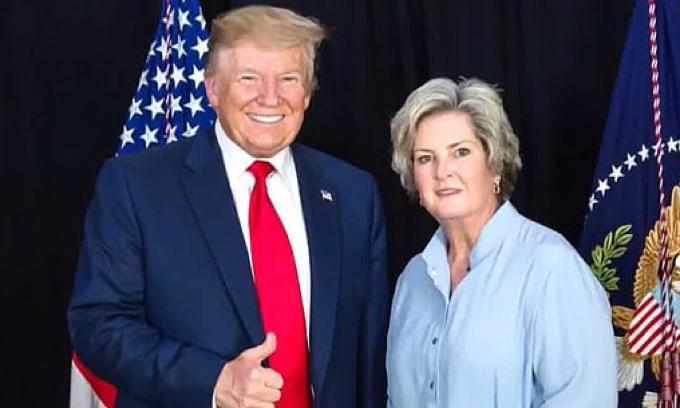
WASHINGTON—A little more than two weeks ahead of a key deadline, White House Chief of Staff Susie Wiles met with Senate Republicans as lawmakers work through disagreements in their version of the One Big Beautiful Bill Act.
The June 18 meeting came two days after the Senate Finance Committee released its draft of its key section of the legislation, which differs significantly from what passed in the House almost a month ago.
The Senate’s version alters provisions on Medicaid and state and local tax (SALT) deductions, among others. The draft bill would also phase out Biden-era green energy subsidies less quickly than the House version.
Whatever the Senate passes must ultimately be reconciled with the House language before President Donald Trump can add his signature to the legislation. Republicans aim to wrap it all up by July 4, about half a month after Wiles’s appearance on Capitol Hill.
Her visit underscores the Trump administration’s interest in getting the package across the finish line. It comes a day after Vice President JD Vance met with Senate Republicans. On June 12, Wiles’s White House deputy, Stephen Miller, took part in a similar get-together in the upper chamber.
Sen. Rick Scott (R-Fla.) said that “everybody I talk to in the White House would like to get the bill by July 4.”
The Independence Day goal is drawing some skepticism.
Sen. John Kennedy (R-La.) pointed out that his chamber doesn’t always stick to its stated timelines.
“The Senate loves deadlines—and what we really like is the whooshing sound they make when they go right by and we don’t achieve them,” he told reporters.
He predicted the bill would lose two votes—enough to squeak by with only GOP support and no need for a tiebreaking vote from Vance.
“It is impossible to make everybody, at least in the Republican conference in the United States Senate, happy,” Kennedy said.
Sen. Markwayne Mullin (R-Okla.) said Wiles did not bring up the July 4 deadline during her talks with lawmakers.
“She just said it’s important to pass it,” Mullin told reporters.
The Oklahoman suggested differences in the Medicaid language in the bill, including a decrease in the provider taxes that states can levy on health care providers, could be brought closer to the House’s version. Yet, he set an even lower threshold than Kennedy for support in the Senate.
“Everything’s on the table,” he said before floating a target of 51 votes—“50 plus JD,” the vice president.
He predicted a vote as soon as the end of next week. That would be a week before July 4.
“If not, we’re going to be here throughout the weekend, and I bet then the numbers come together and the language comes together pretty quickly,” he said.
Sen. John Hoeven (R-N.D.) laid out a similar timeline.
“I’m certainly hopeful we get it done on or before the weekend,” he told reporters.
Yet, Sen. Ron Johnson (R-Wisc.), who was also in the meeting, told reporters he was more pessimistic about a vote happening soon.
Alex Epstein, author of the 2022 book “Fossil Future: Why Global Human Flourishing Requires More Oil, Coal, and Natural Gas—Not Less,” also participated in the June 18 meeting with Wiles and Republican senators.
As the Senate and the House weigh a compromise on when and how to phase out green energy credits, Epstein has taken to X to float his own proposal, which he calls “Subsidy-free by 2028.”
Mullin told reporters that he communicates with Epstein “on a pretty regular basis.”
“I call him a nerd in this area,” he added.







Recent Comments